
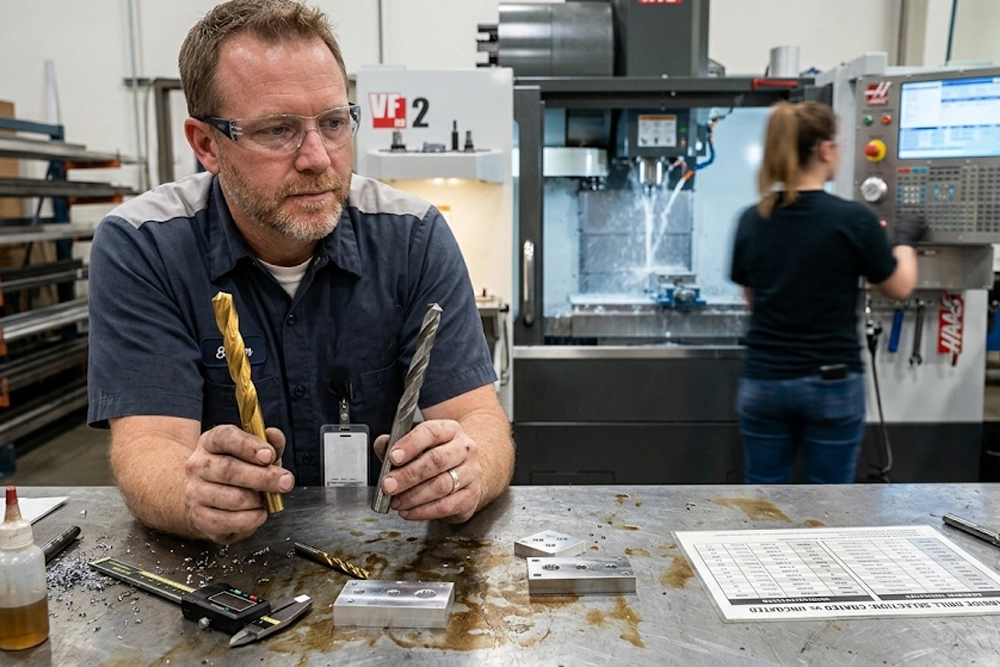
Selecting the right drill is important for achieving accurate holes, maintaining tool life, and controlling machining costs. Among the available options, coated and uncoated carbide drills are both widely used, but their performance can differ depending on the work piece material, cutting conditions, machine setup, and production requirements. Understanding these differences can help manufacturers choose a drill that matches the application rather than simply selecting the most expensive option.
Understanding Carbide Drills
Carbide drills are manufactured using hard carbide substrates that provide high wear resistance and dimensional stability. They are commonly used for CNC drilling where accuracy, productivity, and consistent hole quality are important.
The main difference between coated and uncoated versions is the additional surface layer applied to coated drills. Coatings can improve resistance to wear, heat, friction, and material adhesion. However, the coating does not automatically make a drill suitable for every application. The carbide grade, drill geometry, edge preparation, coating, and machining parameters all need to work together.
What Are Uncoated Carbide Drills?
Uncoated carbide drills have a cutting surface without an additional coating layer. Their performance depends mainly on the carbide substrate and the drill’s geometry. They can be useful when machining softer or adhesive materials where maintaining a sharp cutting edge and effective chip evacuation is particularly important. For example, aluminum and certain non-ferrous materials may benefit from a polished, uncoated tool or a tool with a specialized surface treatment.
Uncoated drills may also make sense for short production runs, prototyping, or applications where extreme tool life is not the main requirement. Their lower initial cost can be useful when the number of holes being produced is relatively small. However, they can experience faster wear when exposed to high temperatures, abrasive materials, or demanding continuous production conditions.
What Are Coated Carbide Drills?
Coated carbide drills have a thin surface layer designed to improve specific performance characteristics. Depending on the application, coatings such as TiN, TiAlN, AlCrN, or other specialized coatings may be used.
The coating can improve wear resistance and reduce friction between the tool and work piece. Some coatings also provide greater resistance to heat and oxidation, making them useful for demanding machining operations. Research comparing coated and uncoated carbide drills has shown that suitable coatings can improve wear behavior and hole quality in particular applications. For example, a study on titanium alloy drilling found that TiAlN-coated carbide drills achieved longer tool life and better surface finish than uncoated drills under the tested conditions.
Key Factors to Consider Before Choosing
- Workpiece Material: The material being drilled should be one of the first considerations. Steel, stainless steel, titanium, aluminum, brass, composites, and other materials place different demands on the cutting edge. Harder and more abrasive materials may benefit from a suitable coating, while softer materials may sometimes perform better with an uncoated or specially treated drill.
- Cutting Speed and Feed: Machining parameters have a direct effect on heat generation and tool wear. High-speed CNC operations can place greater thermal demands on the drill. A properly selected coating can help the tool withstand these conditions, but the recommended speed and feed should always be based on the drill manufacturer’s specifications and the workpiece material.
- Production Volume: Production quantity also affects the decision. For occasional drilling or small batches, an uncoated drill may provide sufficient performance without adding coating costs. For high-volume production, longer tool life can become more important. A coated drill may reduce the frequency of tool changes and help maintain consistent machining results over longer production cycles.
- Hole Quality Requirements: Hole diameter, roundness, surface finish, and dimensional consistency are important in precision manufacturing. Tool wear can gradually affect these characteristics. Studies have found that certain coated carbide drills can maintain better wear resistance and hole quality under specific drilling conditions.
- Coolant and Machining Environment: The use of coolant, minimum-quantity lubrication, or dry machining can influence drill selection. Heat management becomes especially important when drilling difficult materials or operating at higher speeds.
The coating should therefore be selected according to the complete machining environment rather than considered separately from the cutting parameters.
Coated versus Uncoated Carbide Drills: A Simple Comparison
| Factor | Uncoated Carbide Drills | Coated Carbide Drills |
| Surface treatment | No additional coating | Protective coating applied |
| Initial cost | Generally lower | Generally higher |
| Wear resistance | Depends mainly on carbide grade | Often improved with suitable coating |
| Heat resistance | Depends on substrate and conditions | Often improved |
| Soft materials | Often suitable | Depends on coating |
| Hard materials | Application dependent | Often suitable with the right coating |
| High-volume production | Application dependent | Can provide longer tool life |
| Coating selection | Not required | Must match the application |
When Should You Choose an Uncoated Drill?
An uncoated carbide drill can be considered when working with softer materials, performing short production runs, or when a sharp cutting edge and uncomplicated tool configuration are priorities. For non-ferrous materials, especially those prone to sticking to the cutting edge, the right uncoated or polished tool can provide effective chip evacuation and cutting performance.
When Should You Choose a Coated Drill?
A coated carbide drill can be useful when drilling harder materials, performing extended production runs, or working under conditions where heat and abrasive wear are significant concerns. The key is selecting the coating according to the workpiece and machining conditions. A coating that performs well for one material may not provide the same benefits for another. This is why manufacturers should consider technical recommendations from a reliable cutting tools supplier UAE when selecting the appropriate drill specification.
Consider Total Tooling Cost, Not Just Purchase Price
The cheapest drill is not necessarily the most economical option over the complete production cycle. Tool life, number of tool changes, machining time, scrap rates, and hole quality can all affect the overall cost.
For example, if a coated drill costs more but lasts considerably longer under the same production conditions, its cost per hole may be lower. Conversely, paying extra for a coating that does not suit the workpiece can provide little practical benefit. This is why comparing performance based on the actual application is more useful than comparing drill prices alone. A knowledgeable cutting tools supplier UAE can help evaluate the material, machine capability, cutting parameters, and expected production volume before recommending a drill.
Choosing between coated and uncoated carbide drills depends on the complete machining application. Uncoated drills can be practical for suitable materials and lower-volume work, while coated drills can offer advantages in demanding operations where wear, heat, and production consistency are important.
Rather than choosing based only on coating or price, consider the workpiece material, hole requirements, cutting speed, feed rate, coolant conditions, machine rigidity, and production volume. Discussing these factors with an experienced cutting tools supplier UAE can help ensure the selected carbide drill provides the right balance of performance, tool life, and machining cost.