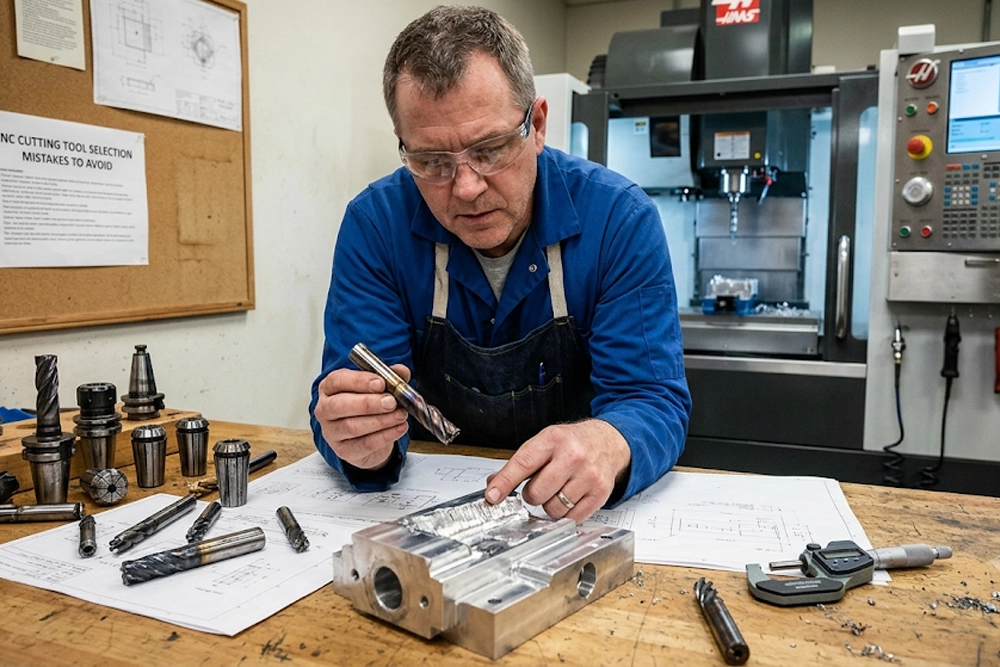
Selecting the right tool is one of the most important steps in achieving accurate, efficient, and consistent CNC machining results. The wrong choice can lead to excessive tool wear, poor surface finishes, dimensional inaccuracies, vibration, and unnecessary production costs. With so many tool materials, geometries, coatings, sizes, and designs available, it can be easy to choose a tool based on price, availability, or familiarity rather than the actual machining requirements. Choosing the right tool can make a major difference in machining accuracy, surface quality, production speed, and overall costs. However, even experienced machinists can make simple mistakes when selecting tools for a job. Understanding the common mistakes involved in CNC cutting tool selection can help machinists and manufacturers make better decisions, extend tool life, improve productivity, and maintain the desired quality of finished components.
Avoid These Common CNC Cutting Tool Selection Errors
- Choosing a Tool without Considering the Material: One of the most common mistakes is selecting a tool without first considering the workpiece material. Aluminium, stainless steel, titanium, cast iron, and hardened steel all behave differently during machining. A tool that performs well on aluminium may not be suitable for harder alloys. The material’s hardness, abrasiveness, thermal conductivity, and tendency to create built-up edges should all be considered before making a choice. For example, carbide tools can be a practical option for many demanding machining operations because of their hardness and wear resistance. However, the tool geometry and coating also need to match the material being machined.
- Ignoring the Type of Machining Operation: Not every tool is designed for every operation. Drilling, milling, turning, threading, chamfering, and finishing each require different tool characteristics. Before selecting a tool, identify what the operation needs to accomplish. Roughing may require a tool designed to remove material quickly, while finishing generally demands better control over surface quality and dimensional accuracy. Using a finishing tool for heavy roughing can cause premature wear or even tool failure. Similarly, using an aggressive roughing tool for a delicate finishing operation may result in an unsatisfactory surface.
- Overlooking Tool Geometry: Tool geometry directly affects cutting performance. Factors such as rake angle, clearance angle, flute design, cutting-edge shape, and helix angle can influence chip evacuation, cutting forces, heat generation, and surface finish. It is easy to focus only on tool size or material and overlook geometry. However, two tools made from the same material can deliver very different results because of their designs. The geometry should therefore be selected according to the workpiece material, machining operation, machine capability, and required finish.
- Selecting the Wrong Tool Size: Tool dimensions should match both the component and the machine setup. Choosing a tool that is unnecessarily long can increase deflection and vibration, particularly during deep cutting. On the other hand, a tool that is too short may not reach the required machining depth. Whenever possible, choose the shortest suitable tool that can safely access the required feature. A stable setup generally improves accuracy and helps reduce unwanted vibration.
- Using Incorrect Cutting Parameters: Even a high-quality tool can perform poorly when cutting parameters are unsuitable. Spindle speed, feed rate, depth of cut, and cutting speed should be selected according to the tool and workpiece. Running too fast can generate excessive heat and accelerate wear. Feeding too slowly can cause rubbing rather than efficient cutting. Excessive depth of cut can also increase cutting forces and place unnecessary stress on the tool and machine. Always refer to the manufacturer’s recommended parameters and adjust them according to the actual machining setup.
- Forgetting about Coolant and Chip Evacuation: Heat and chips are unavoidable parts of machining, but poor control of either can create problems. Inadequate coolant delivery can increase temperature and reduce tool life, especially during demanding operations. Chip evacuation is equally important. If chips remain trapped around the cutting area, they can be recut, damage the workpiece, or interfere with the cutting edge. The tool design, coolant method, machine setup, and workpiece material should all be considered together to achieve effective chip control.
- Ignoring Machine Capability: A tool should not be selected independently of the machine. Before making a choice, check the machine’s spindle speed range, available power, tool-holding system, rigidity, and maximum cutting capacity. For instance, a tool may be technically suitable for a particular material but unsuitable for a machine that cannot provide the required speed or power. Matching the tool to the machine helps create a more stable and predictable machining process.
- Choosing Without Considering Tool Holding: Tool holding is sometimes treated as a secondary concern, but it can significantly affect machining performance. Poor runout, inadequate gripping force, or an unsuitable holder can reduce accuracy and increase vibration. Even a well-designed cutting tool cannot deliver its full potential if it is held incorrectly. Check compatibility between the tool shank, holder, spindle, and machine. For precision work, maintaining low runout is particularly important.
- Neglecting Tool Coatings: Coatings can improve wear resistance, reduce friction, and support better performance in specific machining conditions. However, not every coating is suitable for every application. A coating designed for high-temperature machining may not necessarily be the best option for another material or operation. When comparing CNC cutting tools, consider whether the coating is appropriate for the workpiece material, cutting conditions, and expected tool life. The right coating can make a noticeable difference in demanding applications.
- Failing to Consider the Component Design: The shape and features of the component should influence tool selection. Deep pockets, narrow slots, complex contours, thin walls, and small holes may require specialized tool geometries or dimensions. Trying to use one general-purpose tool for every feature can compromise both productivity and accuracy. Review the component drawing before machining and identify areas that require special access or finishing. Planning tools around the component can reduce unnecessary tool changes and improve workflow.
What Makes Good CNC Cutting Tool Selection?
Effective CNC cutting tool selection is not simply about finding a tool that can remove material. It involves looking at the complete machining process. Consider these factors before making your choice:
- Workpiece material: Understand hardness, abrasiveness, and thermal behavior.
- Machining operation: Match the tool to roughing, finishing, drilling, threading, or another operation.
- Machine capability: Check spindle speed, power, rigidity, and tooling compatibility.
- Tool geometry: Select the appropriate flute design, angles, and cutting-edge configuration.
- Tool dimensions: Avoid excessive tool length and choose a suitable diameter.
- Cutting parameters: Follow recommended speeds, feeds, and depths of cut.
- Coolant and chip control: Ensure heat and chips can be managed effectively.
- Tool life: Consider productivity and cost per component rather than purchase price alone.
Avoiding tool selection mistakes starts with understanding the relationship between the tool, machine, material, and machining operation. Taking a few extra minutes to evaluate these factors can prevent tool failures, improve surface finish, maintain dimensional accuracy, and reduce production costs.
Rather than choosing a tool based on price or habit, treat every machining job as a combination of specific requirements. With careful planning and the right information, CNC cutting tools selection becomes a more reliable part of achieving consistent machining results.