Modern machining demands tools that can withstand high cutting speeds, intense heat, friction, and continuous wear. This is where advanced coating technologies have become increasingly important. By applying a carefully engineered coating to the tool surface, manufacturers can improve hardness, reduce friction, control heat, and extend tool life without changing the underlying tool material.
For industries involved in precision manufacturing, aerospace, automotive, mould making, and general engineering, coated carbide cutting tools can offer better performance and more consistent machining results. Understanding the available coating technologies can help manufacturers select tools that match their materials, machining conditions, and production requirements.
Why Are Carbide Tools Coated?
Carbide tools are already known for their hardness and wear resistance, but demanding machining applications can expose them to extreme temperatures and mechanical stresses. A suitable coating creates an additional protective layer between the cutting edge and the workpiece. Some important benefits include:
- Higher wear resistance: Coatings protect the tool from abrasive and adhesive wear during machining.
- Improved heat resistance: Advanced coatings can withstand the high temperatures generated during high-speed cutting.
- Lower friction: A smoother tool surface can reduce friction between the cutting tool and workpiece.
- Longer tool life: Reduced wear allows tools to remain effective for longer production runs.
- Higher cutting speeds: Certain coatings allow tools to operate efficiently under demanding cutting conditions.
- Better surface finishes: Consistent cutting performance can contribute to improved workpiece quality.
The right coating, however, depends heavily on the application. There is no single coating that is ideal for every machining operation.
Common Coating Technologies
- Titanium Nitride (TiN): TiN is one of the most established tool coatings and is easily recognized by its characteristic gold appearance. It provides good hardness, wear resistance, and reduced friction compared with an uncoated tool. TiN is commonly used for general-purpose machining and can perform effectively when cutting conditions are moderate. However, newer coating technologies can provide better performance in high-temperature applications.
- Titanium Carbonitride (TiCN): TiCN combines titanium, carbon, and nitrogen to provide greater hardness and wear resistance than conventional TiN coatings. Its properties make it useful for applications where abrasive wear is a concern. TiCN-coated tools are often considered for machining materials where maintaining edge durability is important. They can also provide good performance in interrupted cutting applications when the coating and tool geometry are properly selected.
- Titanium Aluminium Nitride (TiAlN): TiAlN has become an important coating for demanding machining applications. The addition of aluminium improves the coating’s resistance to high temperatures and oxidation. This makes TiAlN particularly suitable for high-speed machining and applications where significant heat is generated. It can be used for machining a variety of steels, stainless steels, cast irons, and other engineering materials.
- Aluminium Titanium Nitride (AlTiN): AlTiN is another advanced coating designed for high-temperature machining. It has strong thermal stability and can form a protective aluminium-rich oxide layer during operation. This characteristic helps protect the tool when cutting temperatures become high. AlTiN coatings are therefore frequently considered for dry machining, high-speed operations, and demanding milling applications.
- Multilayer and Nano-Coatings: Modern coating development has moved beyond single-layer systems. Multilayer coatings combine different materials in carefully engineered structures to achieve a balance of hardness, toughness, thermal resistance, and friction control. Nano-structured coatings can use extremely fine layers or structures to improve mechanical and thermal properties. These technologies are particularly valuable when manufacturers need consistent performance under demanding production conditions.
How Advanced Coatings Improve Tool Performance?
The main purpose of a coating is not simply to make a tool harder. Its performance depends on how effectively it manages several factors during cutting. During machining, friction between the tool and workpiece generates heat. Excessive heat can soften the cutting edge, accelerate wear, and negatively affect dimensional accuracy. Advanced coatings help reduce friction and protect the tool substrate from these effects.
Coatings can also improve resistance to abrasion and adhesion. This is especially important when machining materials that tend to stick to the cutting edge or generate significant abrasive forces. In high-speed CNC operations, these advantages can translate into longer tool life, fewer tool changes, and more stable production cycles.
Choosing the Right Coating for the Application
Selecting a coating should be based on the complete machining process rather than coating specifications alone. Manufacturers should consider the workpiece material, cutting speed, feed rate, depth of cut, coolant conditions, and type of machining operation.
For example, a coating suitable for high-speed milling may not necessarily provide the same benefits during low-speed interrupted cutting. Similarly, machining aluminium requires different considerations from machining hardened steel or cast iron.
Tool geometry is equally important. Even an advanced coating cannot compensate for an unsuitable cutting edge, incorrect tool geometry, or inappropriate machining parameters. Working with an experienced CNC cutting supplier UAE can help manufacturers identify suitable combinations of tool material, coating, geometry, and application requirements.
The Role of PVD and CVD Processes
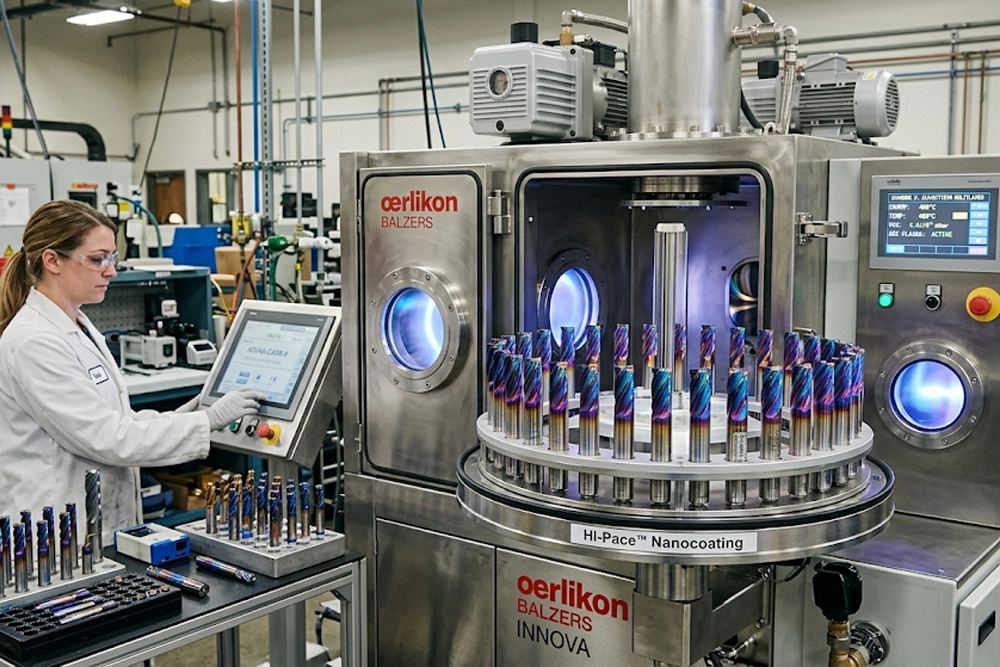
Many advanced tool coatings are applied using technologies such as Physical Vapor Deposition (PVD) and Chemical Vapor Deposition (CVD).
- PVD is widely used for carbide tooling because it can produce thin, hard coatings while maintaining the underlying tool geometry. The process is particularly useful for applications where a sharp cutting edge is important.
- CVD can produce thicker coatings and is known for strong adhesion and excellent wear resistance. It is commonly used for applications where high-temperature performance and durability are priorities.
The choice between these processes depends on the desired coating properties, tool design, and machining application.
What Does This Means for Modern CNC Machining?
As manufacturers continue to increase productivity, coating technology is becoming an important part of cutting-tool development. Higher spindle speeds, harder materials, tighter tolerances, and automated production all place greater demands on cutting tools.
Advanced coatings help address these challenges by providing a protective surface engineered for specific machining conditions. When combined with the right carbide grade, tool geometry, and cutting parameters, they can support more predictable tool performance. For manufacturers sourcing carbide cutting tools, it is therefore useful to look beyond the basic tool material and examine the coating technology being offered. Factors such as coating composition, application method, thickness, thermal resistance, and intended machining material can all influence results.
Advanced coating technologies have transformed the capabilities of carbide tooling. From traditional TiN coatings to high-performance TiAlN, AlTiN, multilayer, and nano-structured solutions, manufacturers now have a wider range of options for improving tool durability and machining performance.
The most suitable coating depends on the application, so tool selection should consider the workpiece, machining process, operating conditions, and required tool life together. By choosing the appropriate coated tool and machining parameters, manufacturers can achieve more stable cutting, reduce unnecessary tool changes, and support efficient CNC production. For companies looking for reliable tooling solutions, partnering with an experienced CNC cutting supplier UAE can make it easier to select coating technologies that align with specific machining requirements.